Hijab Travel Tips for Bali: A Practical Guide
 Halal Luxury Bali Editorial Desk
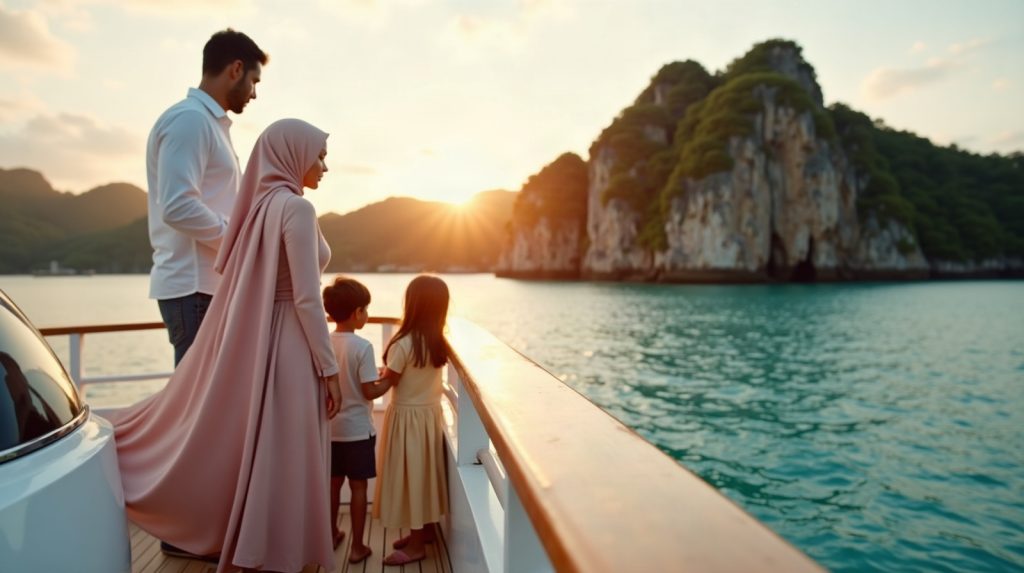
The most useful hijab travel tips for Bali come down to three things: you can wear hijab everywhere on the island without any issue, burkinis are accepted at public beaches and most hotel pools, and a private pool villa gives you the freedom that shared resort facilities cannot. Bali is a Hindu-majority island within Muslim-majority Indonesia, so locals are completely familiar with hijabi guests — as of 2026, Muslim travelers from Malaysia, Singapore, the Middle East, and across Indonesia are among Bali’s largest visitor groups. This guide covers what actually matters on the ground: dress norms at temples and beaches, burkini and pool rules, where to shop for modest activewear, and how to keep prayer and halal food simple while you travel.
Is Bali Comfortable for Women Who Wear Hijab?
Yes — genuinely comfortable, not just tolerated. Hijab is a normal sight in Bali. Many shop staff, drivers, and hotel employees are themselves Muslim Indonesians, and no restaurant, mall, attraction, or government office restricts headscarves. You will not be asked to remove your hijab anywhere, including at temples, immigration, or airport security (a female officer handles checks where needed).
The practical challenges are different from what many first-time visitors expect. The real issues are heat and humidity (Bali sits at 27–32°C year-round with high humidity), finding pools where you can swim without an audience, and knowing which venues have dress codes. Each of those has a straightforward solution, covered below.
What Should You Wear at Temples, Beaches, and Restaurants?
Dress norms in Bali vary by setting rather than by religion. Here is the quick version:
| Location | Dress norm for hijabi travelers |
|---|---|
| Hindu temples (Uluwatu, Tanah Lot, Besakih) | Sarong and sash required for all visitors — provided or rented at the entrance. Shoulders and knees covered. Hijab is completely fine; most hijabi outfits already exceed the requirement. |
| Public beaches | No dress code. Burkinis, long sleeves, and hijab are all normal. You will see everything from bikinis to full coverage on the same beach. |
| Beach clubs and day clubs | Venue-specific dress codes; some require standard swimwear in pools. Check the policy before booking a daybed. |
| Restaurants, malls, attractions | No restrictions. Smart-casual modest wear is ideal everywhere. |
| Private villa | Entirely up to you — this is why villas are the default choice for Muslim families. |
One temple-specific note: Balinese temple etiquette asks all visitors — regardless of faith — to wear the sarong and sash and to avoid entering during menstruation. This is a Balinese Hindu custom, communicated politely at every major temple, and it applies equally to everyone.
Are Burkinis Allowed in Bali’s Pools and Beaches?
On public beaches, yes, without exception — a burkini in Seminyak, Nusa Dua, or Sanur draws no attention at all. Hotel pools are generally burkini-friendly too, especially at resorts in Nusa Dua that host many Middle Eastern and Southeast Asian guests. A small number of beach clubs enforce “standard swimwear only” policies in their pools, usually citing water hygiene rules, so it is worth confirming in advance rather than being turned away at the door.
The cleanest solution — and the reason most of our returning guests never book hotel rooms — is a private pool villa. A villa with high privacy walls around the pool means you can swim in whatever you choose, or without hijab entirely, with no sightlines from neighbors or staff walkways. When we vet properties for our halal villas in Bali collection, pool privacy is one of the first things we physically check: wall height, overlooking balconies from adjacent buildings, and whether staff schedules can be arranged so the pool area is completely private during your swim times. Seminyak and Canggu have excellent options, and quieter areas like Umalas offer even more seclusion.
Practical Hijab Travel Tips for Bali’s Tropical Climate
Bali’s heat is humid rather than dry, which changes what works. These hijab travel tips for Bali come from what guests consistently tell us they wish they had packed:
- Choose breathable fabrics: cotton voile, bamboo jersey, or lightweight chiffon hijabs. Thick jersey underscarves trap heat — switch to thin cotton or mesh-back sports underscarves.
- Pack more hijabs than days: humidity means you may want a fresh scarf by afternoon. Light colors reflect heat and photograph beautifully against Bali’s greenery.
- Bring a sports hijab: essential for ATV rides, waterfall treks, snorkeling, and the Mount Batur sunrise hike. Swim-rated sports hijabs double as burkini headpieces.
- Two burkinis minimum: in humid air, swimwear dries slowly. Alternating two sets means you always have a dry one.
- A light open abaya or kimono: works as a beach cover-up, temple layer, and evening restaurant outfit in one.
- Travel prayer set: a compact mukena and pocket prayer mat make praying easy at waterfalls, rice terraces, or between tour stops.
For waterfall visits — Tegenungan, Tibumana, Sekumpul — wear your burkini under quick-dry clothing so you can swim without needing a changing room, which many waterfall sites lack.
Where Can You Shop for Modest Activewear in Bali?
If you arrive underpacked, Bali can fix it. Denpasar is the island’s Muslim fashion hub: the textile shops along Jalan Sulawesi sell fabrics and ready-made modest wear at local prices, and the city’s malls and department stores carry Indonesian modest-fashion brands, including sports hijabs and swim-rated modest swimwear. Indonesia has one of the world’s largest modest fashion industries, so selection and pricing here are far better than in most Western destinations — as an indication, a quality sports hijab typically costs the equivalent of USD 8–20 and a full burkini set USD 25–60 in local shops, though prices vary by brand and season. In the tourist areas, the larger malls in Kuta and Denpasar are your best bet; boutique surf shops in Seminyak and Canggu also stock rash guards and leggings that work well for modest water sports.
If you would rather not spend holiday time hunting for shops, our halal concierge service can source specific items — sizes, brands, swim-rated pieces — and have them delivered to your villa before you even need them.
How Do Prayer, Halal Food, and Spa Days Work in Bali?
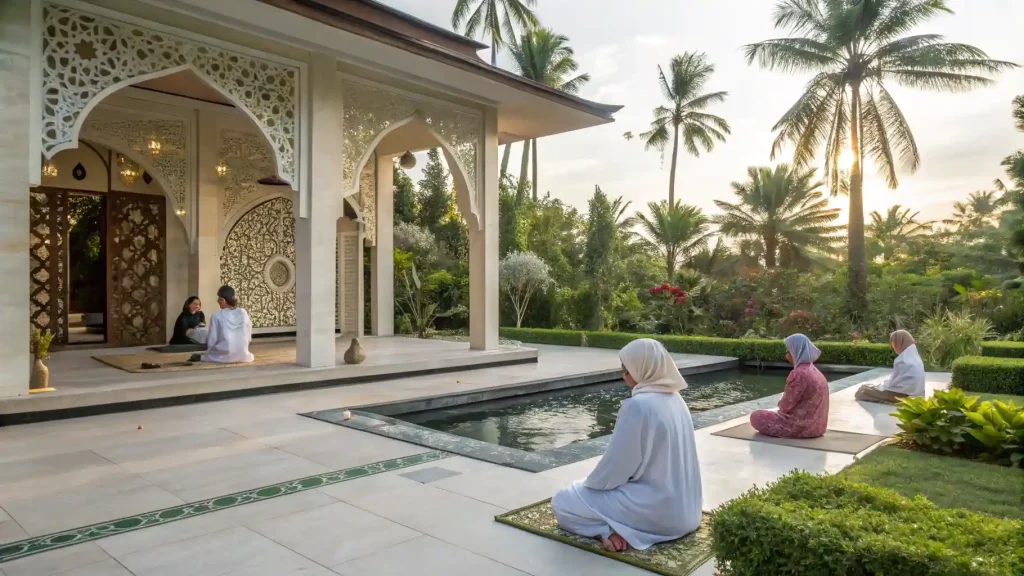
Prayer is easier than most visitors expect. Ngurah Rai International Airport has a musholla, so you can pray on arrival before your transfer. Masjid Agung Sudirman in Denpasar is the island’s landmark mosque, and Masjid An-Nur in Kuta serves the main tourist corridor — both welcome women with dedicated prayer spaces. Most malls and many attractions have prayer rooms, and any villa can be set up with prayer mats and qibla direction on request.
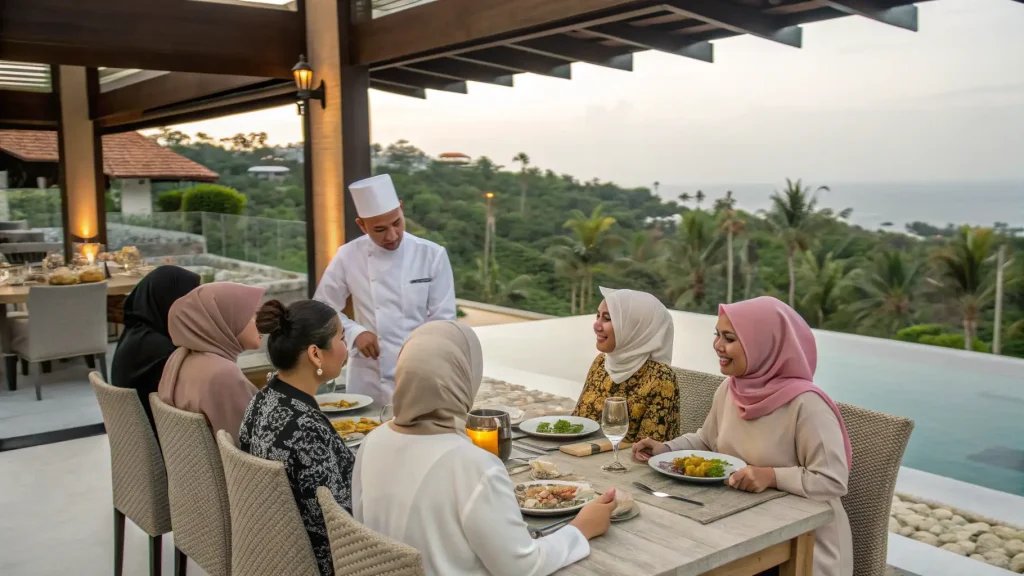
Halal dining is well established: Seminyak, Nusa Dua, and Kuta all have certified halal restaurants alongside the many local Muslim-owned warungs serving Indonesian classics. For villa stays, a private halal chef is the upgrade most families rate highest — full control over ingredients, and no nightly restaurant research.
For spa days, the standard hijabi checklist is: female therapist, fully private treatment room, and prayer-time-aware scheduling. Not every famous spa can guarantee all three, which is why we maintain a vetted list — see our guide to halal spa and wellness in Bali for how we screen them.
When Should Muslim Women Plan a Bali Trip?
High season runs July–August, and the Eid al-Fitr holiday period brings a major wave of regional Muslim travelers — expect the best atmosphere but also peak villa rates and earlier sell-outs of the most private properties. As of 2026, the sweet spots for hijabi travelers are May–June and September: dry-season weather, thinner crowds at temples and waterfalls, and better availability of villas with walled pools. If you are targeting Eid or the school holidays, book your villa three to six months ahead.
Travel with Everything Arranged for You
Every tip in this guide — the walled-pool villa, the female spa therapist, the halal chef, the burkini-friendly itinerary, the prayer-time-aware tour schedule — is exactly what we arrange end to end. Halal Luxury Bali is part of Juara Holding Group, operating from Bali across Indonesia since 2015, so the villas, drivers, chefs, and guides we book are ones we work with continuously, not names from a directory.
Tell us your dates and who is traveling, and we will design a fully halal, fully private Bali itinerary around you. Message our team on WhatsApp at +62 811-2859-0000 or email sales@balipremiumtrip.com — we usually reply within a few hours.